Core Components of a Database Modernization Program
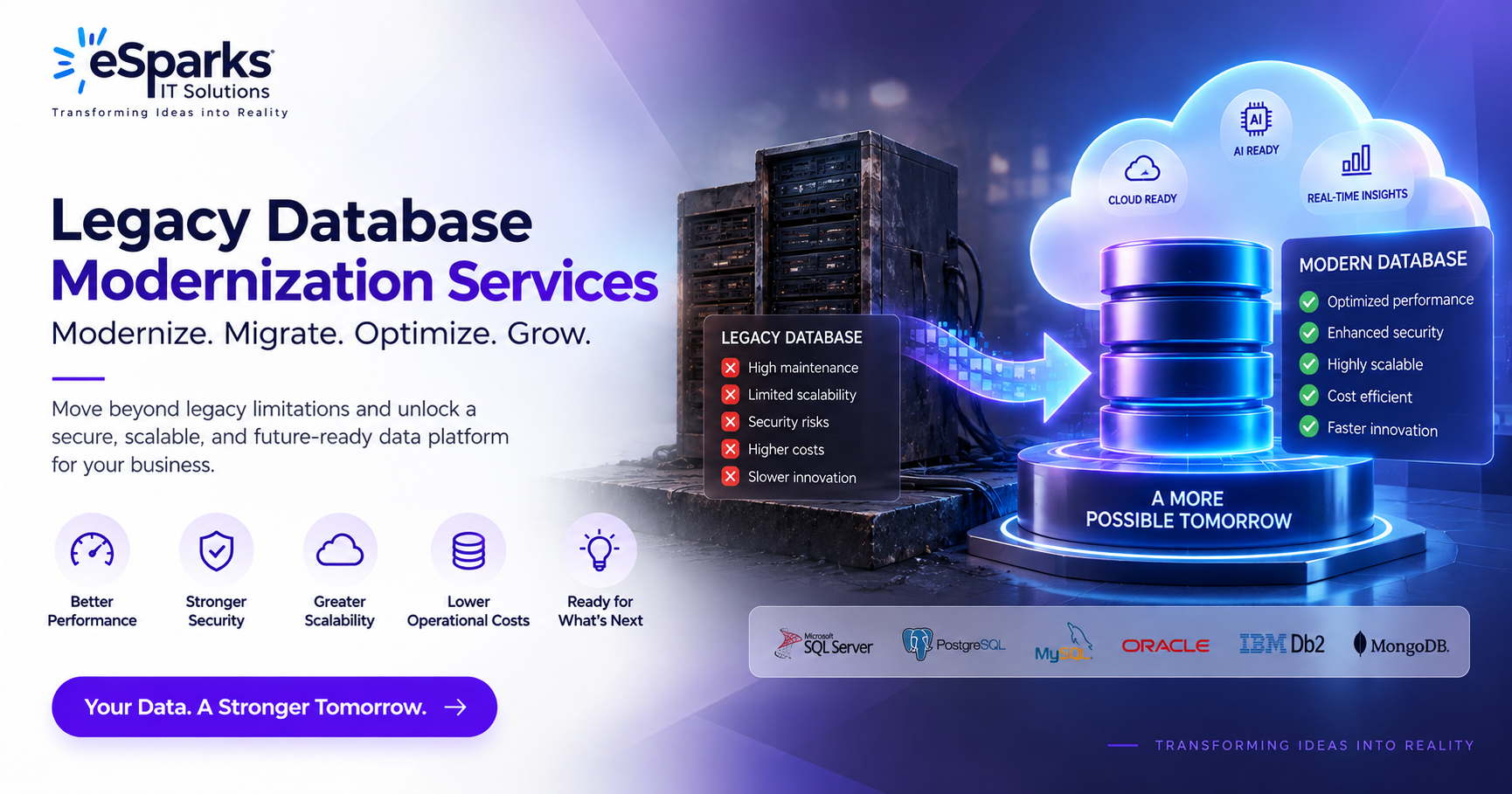
Legacy Database Modernization Services: Building a Future-Ready Data Foundation
Many organizations still depend on databases that were designed years or even decades ago. These systems may continue to process transactions reliably, but that does not mean they are ready for today's requirements.
Modern applications expect faster data access, stronger security, flexible integrations, cloud scalability, automated operations, and real-time analytics. When an aging database cannot easily support these requirements, it can become a constraint on application development and business growth.
Legacy database modernization services help organizations address this gap by evaluating existing database environments, identifying technical and operational limitations, and moving toward a more scalable and maintainable data architecture.
However, modernization is not simply about replacing an old database with a new one. The right approach considers the applications connected to the database, the quality and structure of the data, business continuity requirements, security, future workloads, and the organization's long-term technology strategy.
Key Takeaways Legacy databases can create hidden costs even when they continue to operate successfully. Modernization should begin with an assessment of workloads, dependencies, data quality, and business requirements. A database does not necessarily need to be replaced completely; modernization can range from targeted upgrades to architectural transformation. Cloud adoption, real-time analytics, AI applications, and API-driven systems are increasing the demands placed on enterprise databases. Migration planning should include data validation, application testing, security controls, monitoring, and recovery procedures. A phased modernization strategy can reduce operational risk and make complex database transformation easier to manage. Why Are Organizations Modernizing Legacy Databases?
A database can remain operational for years while gradually becoming more expensive and difficult to maintain.
Older environments are often surrounded by custom scripts, manually managed infrastructure, undocumented integrations, outdated drivers, and application code that depends heavily on database-specific behavior.
The problem usually becomes visible when the organization tries to make a change.
For example, a business may want to:
Move an application to the cloud Launch a new mobile application Introduce real-time reporting Integrate with a SaaS platform Build AI-powered features Improve disaster recovery Reduce database licensing costs Upgrade an unsupported database version Expand into new regions
What initially appears to be an application project can quickly turn into a database modernization challenge.
This is because the database often sits at the center of multiple business processes.
A modern application architecture therefore requires more than simply keeping the database available. It requires a data platform that can evolve with the business.
Signs That Your Database May Need Modernization
Not every older database needs immediate replacement. However, certain indicators suggest that modernization should be evaluated.
Increasing Maintenance Effort
If database administrators spend significant time applying manual patches, troubleshooting old integrations, managing backups, or maintaining custom scripts, the operational model may no longer be sustainable.
Slow Application Changes
When developers avoid changing database structures because they are afraid of breaking dependent applications, technical debt begins to affect product delivery.
Growing Infrastructure Costs
Older database platforms may require specialized hardware, expensive licenses, or dedicated operational teams.
The cost of maintaining the existing environment can eventually exceed the cost of moving to a modern platform.
Limited Integration Options
Modern businesses often need databases to communicate with APIs, analytics platforms, cloud applications, event streams, and external services.
Legacy architectures can make these integrations unnecessarily complicated.
Security and Compliance Pressure
Unsupported database versions, weak access controls, outdated encryption methods, or inconsistent audit processes can increase security and compliance risks.
Poor Scalability
A database that performs well with today's workload may struggle when transaction volume, users, geographic coverage, or reporting requirements increase.
Modernization provides an opportunity to address these limitations before they become production problems.
What Should a Modern Database Environment Provide?
A modern database architecture should support the organization's current requirements while leaving room for future growth.
Several capabilities are particularly important.
Scalability
The platform should be capable of handling changing workloads without requiring major infrastructure redesign.
Depending on the workload, this may involve vertical scaling, read replicas, partitioning, caching, distributed architectures, or cloud-managed services.
Reliability
Business-critical databases should have clearly defined availability and recovery objectives.
Modern environments can incorporate automated backups, point-in-time recovery, failover mechanisms, replication, and tested disaster recovery procedures.
Security
Database security should cover identity, permissions, encryption, network access, secrets, monitoring, and auditing.
Modernization is an opportunity to remove excessive privileges and replace shared credentials with controlled service identities.
Observability
Teams need visibility into database health and application behavior.
Useful monitoring areas include:
Query latency CPU and memory utilization Connection usage Storage growth Replication lag Failed queries Lock contention Backup status Availability events Integration
The database should work effectively with APIs, applications, reporting platforms, analytics systems, and other business services.
Well-defined interfaces can reduce the dependency on direct database access from multiple applications.
What Do Legacy Database Modernization Services Cover?
A modernization program normally involves several interconnected activities.
Database Assessment
The process begins by understanding what exists.
Teams examine database versions, schemas, tables, indexes, stored procedures, triggers, jobs, integrations, workloads, and operational processes.
The objective is to create a reliable baseline before making architectural decisions.
Dependency Discovery
This is one of the most important parts of modernization.
A database may be connected to:
Web applications Mobile applications APIs Reporting tools ETL pipelines Scheduled jobs Data warehouses Third-party systems Financial platforms Customer portals
Missing even one critical dependency can cause problems during migration.
Data Quality Analysis
Modernization is a good opportunity to identify unnecessary complexity in the data layer.
Teams can analyze duplicate records, inconsistent formats, missing values, invalid relationships, obsolete data, and conflicting reference information.
Cleaning these issues before migration can improve the quality of the target environment.
Schema Modernization
The existing schema may have been optimized for an older application architecture.
Modernization may involve redesigning tables, indexes, relationships, partitioning strategies, data types, or database-specific logic.
Application Compatibility
Database changes can affect application behavior.
SQL syntax, transaction handling, isolation levels, connection management, stored procedures, and date or numeric behavior may differ between database platforms.
Application testing therefore needs to be part of the modernization process.
Migration and Synchronization
Once the target environment is ready, data can be migrated using an appropriate strategy.
Depending on the project, organizations may use bulk migration, replication, change data capture, incremental synchronization, or phased migration.
Choosing Between Different Modernization Approaches
There is no single approach that works for every legacy database.
Upgrade the Existing Platform
Sometimes the database architecture is still appropriate and only the version or infrastructure is outdated.
In this situation, an upgrade may provide a relatively low-risk modernization path.
Move to a Managed Database
Organizations that want to reduce infrastructure management may move from self-managed databases to cloud-managed services.
This can simplify activities such as:
Backups Patching Monitoring High availability Scaling Infrastructure management Migrate to a Different Database Engine
A business may decide that the current database technology no longer fits its long-term strategy.
For example, migration to PostgreSQL or another modern database platform may be considered to improve flexibility, reduce licensing dependency, or align with application architecture.
Such migrations require careful analysis of SQL compatibility, schema differences, stored procedures, data types, and application behavior.
Redesign the Data Architecture
For heavily constrained systems, simply changing the database engine may not be enough.
The organization may need to redesign how data is stored, accessed, integrated, and consumed.
This is a larger transformation but can deliver significant long-term benefits.
How Cloud, Analytics, and AI Are Changing Database Requirements
Modernization decisions are increasingly influenced by new workloads.
Traditional applications primarily required reliable transactional storage.
Today's organizations may also need to support:
Real-time dashboards Machine learning workflows AI applications Customer analytics Recommendation systems Event processing Mobile applications API-based services
This creates new requirements for data availability, integration, governance, and processing.
For example, an operational database may be excellent for transactions but unsuitable for large-scale analytical workloads.
Instead of forcing every workload into one database, organizations can build architectures where transactional systems, analytical platforms, caches, object storage, and specialized services work together.
This can make the overall environment more efficient and easier to scale.
How to Reduce Risk During Modernization
Database modernization should be treated as a controlled transformation rather than a single migration event.
A practical approach is to divide the project into stages.
- Discover
Document databases, applications, integrations, workloads, ownership, and business importance.
- Assess
Evaluate compatibility, technical debt, data quality, performance, security, and operational risks.
- Design
Define the target architecture and decide which workloads should be upgraded, migrated, refactored, or retired.
- Pilot
Run a representative migration using a limited workload.
This allows the team to identify unexpected compatibility or performance issues before production.
- Validate
Compare source and target data and test application functionality.
Validation should include more than row counts. Business rules, relationships, transactions, reports, and application workflows should also be checked.
- Migrate
Move workloads according to a controlled migration schedule.
For critical systems, synchronization technologies can help reduce the amount of data that must be transferred during the final cutover.
- Optimize
Monitor the new environment and tune queries, indexes, connections, storage, and application behavior based on actual workloads.
Common Mistakes to Avoid Starting Without Understanding Dependencies
A migration plan based only on database inventory is incomplete.
Application connections, reports, integrations, scripts, and scheduled processes should also be identified.
Choosing Technology Before Defining Requirements
Selecting a database simply because it is popular can create new problems.
The target platform should be evaluated against actual workload, security, availability, performance, and cost requirements.
Assuming Data Migration Equals Application Migration
Successfully moving data does not guarantee that the application will behave correctly.
Application queries and business workflows need separate validation.
Ignoring Historical Data
Organizations sometimes discover late in the project that old records are required for compliance, reporting, or customer support.
Data retention and archival requirements should be established before migration.
Focusing Only on Migration Cost
A cheaper migration may create higher operational costs later.
The better comparison considers infrastructure, licensing, administration, support, security, performance, and future development costs.
Measuring the ROI of Database Modernization
The value of modernization should not be measured only by whether the migration was completed.
Organizations can evaluate improvements across several areas:
Operational efficiency: How much manual database administration has been eliminated?
Performance: Are application response times and query performance improving?
Availability: Are backup, failover, and recovery processes more reliable?
Security: Are access controls, encryption, and auditing stronger?
Development speed: Can developers introduce database-related changes more quickly?
Cost: Has infrastructure, licensing, or maintenance expenditure decreased?
Business agility: Can new applications, analytics workloads, or integrations be introduced more easily?
A successful modernization project should create measurable improvements in both technology operations and business capability.
What Does a Future-Ready Database Strategy Look Like?
Modernization should not be viewed as a one-time project after which the database is left unchanged for another decade.
A future-ready strategy includes continuous monitoring, regular security reviews, capacity planning, data governance, automated backups, recovery testing, and periodic architecture assessments.
Organizations should also establish clear ownership for database changes and define how new applications will interact with enterprise data.
The long-term objective is simple: make the data platform easier to change than the legacy platform it replaced.
Frequently Asked Questions What are legacy database modernization services?
Legacy database modernization services help organizations assess, improve, migrate, and optimize older database environments. Depending on the business requirement, services can include database assessment, schema modernization, cloud migration, engine conversion, data cleansing, application compatibility testing, security improvements, and post-migration optimization.
When should a company consider modernizing its legacy database?
Modernization should be considered when an aging database creates increasing security, maintenance, performance, scalability, integration, licensing, or support challenges. It is also worth evaluating when the organization is planning cloud adoption, application modernization, analytics initiatives, or AI-driven applications.
Does database modernization always require migrating to the cloud?
No. Cloud migration is one possible modernization strategy, but it is not mandatory. An organization may modernize by upgrading its existing infrastructure, changing the database engine, improving the schema, redesigning application integration, or adopting a hybrid architecture.
How do I choose the right database modernization strategy?
Start by evaluating business criticality, technical debt, workload characteristics, application dependencies, data quality, security requirements, downtime tolerance, and long-term objectives. The result may be an upgrade, replatforming, database migration, refactoring, or complete architectural redesign.
Can a legacy database be modernized while the application remains operational?
In many cases, yes. Migration architectures can use replication, incremental synchronization, change data capture, or phased cutovers to keep source and target environments synchronized. The appropriate approach depends on the database technology, transaction volume, application behavior, and consistency requirements.
How can I validate that migrated data is correct?
Data validation can include record counts, checksums, field-level comparisons, referential integrity checks, business-rule validation, query comparisons, application testing, and reconciliation of critical transactions. For important systems, validation should occur throughout the migration process rather than only after final cutover.
What is the biggest risk in legacy database modernization?
One of the biggest risks is failing to understand dependencies around the database. An apparently simple database may support applications, reports, integrations, scheduled jobs, and business processes that are poorly documented. Thorough discovery and dependency mapping can significantly reduce this risk.
How long does database modernization take?
The timeline depends on database complexity, data volume, number of applications, migration strategy, testing requirements, security needs, and downtime expectations. A focused modernization may take several weeks, while a complex enterprise program may require several months and multiple migration phases.
Is database modernization worth the investment?
It can be, particularly when the existing environment creates significant operational costs or limits business growth. The business case should consider not only migration expenditure but also improvements in security, reliability, development speed, scalability, licensing, infrastructure, and long-term maintenance.
Work with eSparks IT Solutions
Planning a project around this? We help businesses across the USA, UK, Canada, Australia and the GCC ship it. See how we work with clients in the USA. See a related project: Database Migration Platform. Explore our Programming services and portfolio, estimate your project cost, or book a free call.