Beyond Code Reviews: How Secure SDLC Reduces Software Security Risks
Secure SDLC in Practice: How to Build Security Into Every Stage of Software Development
Security is no longer something organizations can afford to review just before a product goes live.
Modern applications connect to cloud infrastructure, APIs, databases, third-party services, mobile devices, AI systems, and external users. Every connection introduces another area that needs to be considered.
That is why organizations are moving from traditional development practices toward a Secure Software Development Lifecycle (Secure SDLC)—an approach where security becomes part of everyday engineering rather than a final checkpoint.
The goal is simple:
Build security into the product while it is being built, not after problems appear.
Why Traditional Development Processes Are Not Enough
In a conventional development process, security can sometimes become concentrated near the end of the project.
Developers build features, testing teams validate functionality, and security teams review the application before release.
The problem is that vulnerabilities discovered at this stage can be expensive to fix.
A security issue may require changes to:
Application architecture Database design Authentication APIs Cloud infrastructure User permissions Business workflows
A Secure SDLC changes the timing of security decisions.
Instead of asking:
“Is this application secure before launch?”
teams continuously ask:
“What security risks are being introduced at this stage?”
- Security Starts With Requirements
Before developers write code, the project should establish its security expectations.
Teams should understand:
What information will the application handle? Which users will access it? What actions require elevated privileges? Which systems will it integrate with? What information must be retained or deleted? What regulatory or contractual requirements apply? What could happen if the system is compromised?
These questions help transform security from a vague objective into measurable requirements.
For example, an application handling customer financial information will require a very different security strategy from an internal employee dashboard.
- Turn Threat Modeling Into a Design Activity
Threat modeling helps development teams think like an attacker before the application exists in production.
Instead of waiting for vulnerabilities to appear, teams identify potential attack paths during design.
Questions might include:
Could one user access another user's information? What happens if an authentication token is stolen? Can an API be called without proper authorization? What happens if a third-party service becomes compromised? Could an attacker manipulate an approval workflow? Where could sensitive information accidentally leak?
This exercise can reveal architectural weaknesses before they become expensive development problems.
- Design Security Into the Architecture
Once threats are understood, security controls can be incorporated into the architecture.
Depending on the application, this could involve:
Identity
Use appropriate authentication, MFA, SSO, and authorization mechanisms.
Data Protection
Protect sensitive information both during transmission and while stored.
API Security
Validate requests, enforce authorization, and limit abusive traffic.
Network Security
Separate environments and reduce unnecessary exposure.
Secrets Management
Keep credentials, tokens, and keys outside application source code.
Least Privilege
Give users, services, and infrastructure only the permissions they actually need.
Good architecture can eliminate entire categories of security problems before development begins.
- Make Developers Part of the Security Process
Security should not belong exclusively to a security team.
Developers make decisions every day that affect application security.
Secure engineering practices should therefore become part of normal development.
This can include:
Peer code review Secure coding guidelines Input validation Output encoding Safe error handling Authentication checks Authorization testing Secure dependency management Secret detection
The objective is not to turn every developer into a security specialist.
It is to give developers the processes and tools required to identify common risks during development.
- Automate Security Inside CI/CD
One of the biggest advantages of modern development pipelines is automation.
Security checks can run automatically whenever code changes.
A pipeline might include:
Code Commit → Code Review → Security Scan → Build → Dependency Check → Testing → Security Gate → Deployment
Common automated checks include:
Static application security testing Dependency scanning Secret scanning Container scanning Infrastructure-as-code scanning API security testing
Automation provides continuous feedback instead of waiting for a final security review.
- Don't Let Security Tools Become the Strategy
Having dozens of security tools does not automatically create a secure application.
Tools can produce:
False positives Duplicate findings Low-priority alerts Large volumes of unresolved issues
The important part is what happens after a finding appears.
Organizations need clear rules for:
Severity Ownership Remediation Exceptions Escalation Release blocking
For example, a critical authentication vulnerability may prevent a release, while a low-risk informational finding may be scheduled for later remediation.
Security needs context and ownership, not just scanning.
- Secure the Software Supply Chain
Modern applications rarely consist entirely of internally written code.
They rely on:
Open-source libraries Frameworks Containers Packages Cloud services Build tools External APIs
Each dependency can introduce additional risk.
A mature Secure SDLC should therefore include dependency visibility and vulnerability management.
Teams should know:
What components are being used Which versions are deployed Which dependencies require updates Where critical vulnerabilities exist How quickly updates can be applied
For larger environments, software bills of materials and controlled build processes can provide additional visibility.
- Cloud Security Must Be Part of the SDLC
Application security and infrastructure security cannot be treated as separate worlds.
A well-written application can still become vulnerable because of an incorrectly configured cloud environment.
Potential problems include:
Public storage Excessive IAM permissions Exposed databases Weak network controls Unprotected backups Over-privileged CI/CD credentials Poor environment separation
Infrastructure-as-code scanning and secure cloud baselines can help identify configuration problems before they reach production.
- Test Security Before Production
Security testing should become progressively deeper as the application approaches release.
Depending on the risk level, organizations may use:
Automated security testing API testing Dynamic application testing Manual security reviews Penetration testing Configuration reviews Access-control testing
Automated tools are useful, but they cannot identify every business-logic vulnerability.
For example, a scanner may not understand that a particular sequence of legitimate actions can be combined to bypass an approval process.
Human review remains important for higher-risk systems.
- Production Is Part of the Security Lifecycle
A Secure SDLC does not end when deployment succeeds.
Once the application is live, organizations need visibility into its behavior.
Operational security may include:
Centralized logging Security monitoring Vulnerability management Access reviews Patch management Backup verification Incident response Disaster recovery
Teams should also know:
Who responds when something goes wrong?
A security process without clear ownership can create delays during an actual incident.
- Measure Security Like Any Other Engineering Activity
Security becomes easier to manage when organizations track meaningful indicators.
Useful measurements can include:
Number of critical vulnerabilities Average remediation time Dependency update age Security issues found before release Failed security checks Production incidents Privileged-access reviews Percentage of applications covered by automated scanning
The purpose is not to create impressive security statistics.
The purpose is to identify weaknesses in the development process and improve them over time.
- Adapt Security Controls to the Risk
Not every application needs the same security investment.
A simple marketing website and a multi-tenant SaaS platform handling sensitive customer information should not have identical security requirements.
A practical model is to establish:
Baseline Controls
Required across all projects:
Secure coding Dependency management Secrets management Access control Basic security scanning Secure environments Enhanced Controls
For higher-risk applications:
Formal threat modeling Advanced API testing Penetration testing Stronger release gates Detailed monitoring Additional access reviews Independent security assessment
This creates risk-based security rather than unnecessary process.
What a Mature Secure SDLC Looks Like
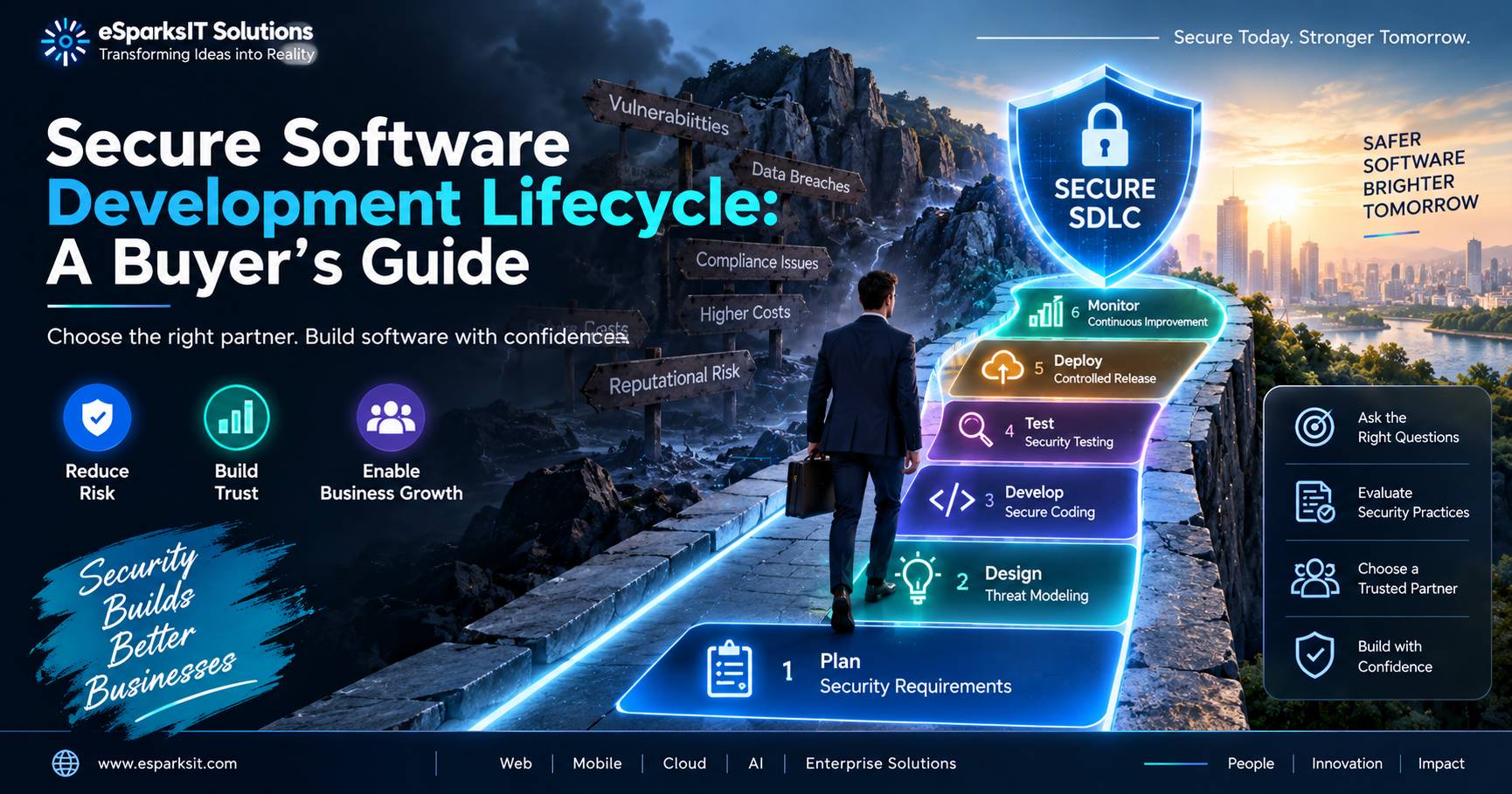
A mature process should connect every stage:
Plan Identify data, users, threats, and requirements.
↓
Design Create secure architecture and define trust boundaries.
↓
Develop Apply secure coding practices and controlled dependencies.
↓
Test Automate security checks and perform deeper assessments.
↓
Release Apply security gates and controlled deployment.
↓
Operate Monitor, patch, review access, and respond to incidents.
↓
Improve Learn from findings and strengthen the development process.
Security becomes a continuous loop rather than a one-time activity.
How Businesses Can Start
Organizations do not need to transform their entire development process overnight.
A practical starting point is to:
Identify your highest-risk applications. Define minimum security requirements. Introduce threat modeling for important projects. Add security checks to CI/CD. Improve secrets and dependency management. Separate development, staging, and production access. Establish vulnerability-remediation ownership. Create an incident-response process. Review the process regularly.
The objective is continuous improvement.
Final Thoughts
Secure SDLC is ultimately about changing when and how organizations think about security.
Instead of waiting for a vulnerability to appear during a final audit—or worse, after a production incident—security becomes part of requirements, architecture, coding, testing, deployment, and operations.
The result is not necessarily slower development.
When implemented intelligently, Secure SDLC can create more predictable releases, fewer expensive surprises, stronger applications, and greater confidence in the software being delivered.
For businesses building modern web, mobile, cloud, SaaS, or AI-powered applications, security should not be a final feature.
It should be part of the engineering process from the first idea to the final release—and every update that follows.
Frequently Asked Questions What is Secure SDLC?
Secure SDLC is a development approach that integrates security practices throughout software planning, design, development, testing, deployment, and operations instead of treating security as a final-stage activity.
Can Secure SDLC improve development efficiency?
Yes. By identifying vulnerabilities and architectural risks earlier, teams can reduce expensive rework and last-minute security problems.
Is automated security testing enough?
No. Automated tools are valuable for identifying common vulnerabilities, dependency issues, secrets, and configuration problems, but manual analysis is still important for business-logic and architecture-level risks.
Does every application need the same security controls?
No. Security should reflect the application's data, exposure, business impact, integrations, and regulatory requirements. Higher-risk systems generally require deeper controls and more extensive testing.
When should security testing begin?
As early as possible. Security requirements and threat modeling should begin during planning and design, followed by automated checks during development and deeper testing before production.
Work with eSparks IT Solutions
Planning a project around this? We help businesses across the USA, UK, Canada, Australia and the GCC ship it. Explore our Programming services and portfolio, estimate your project cost, or book a free call.